Avoid seven common mistakes: buy a kit the drummer can play naturally, calibrate triggers, customize presets, finalize sounds through the PA with the band, provide a balanced stereo mix or direct outputs, avoid duplicate processing, and keep levels musical. Headphones are only a starting point.

I've heard electronic drums sound better than acoustic drums. I've also heard electronic drums sound like a $200 toy from 1998.
Most of the difference comes down to a handful of mistakes churches make during setup. Let me show you the seven biggest ones.
Electronic drum kits can feel dramatically different. Pad size, rebound, hi-hat response, cymbal movement, and kick feel all affect how naturally the drummer can play.
Don’t choose a kit based only on the module, the price, or an online demo. Have your drummer play it. A kit with great sounds is not helpful if the drummer hates playing it.
The drum module needs to understand how your drummer plays. Sensitivity, threshold, velocity curves, hi-hat calibration, and other trigger settings determine how the kit responds.
If those settings are wrong, quiet hits may disappear, normal hits may trigger at full volume, and cymbal swells may sound unnatural. Take time to adjust the kit for the drummer who will actually use it.
Factory presets are designed to demonstrate what the module can do. They are not designed specifically for your church, your PA, your room, or your worship music.
Find a preset that is close, then customize the kick, snare, toms, cymbals, tuning, muffling, and ambiance.
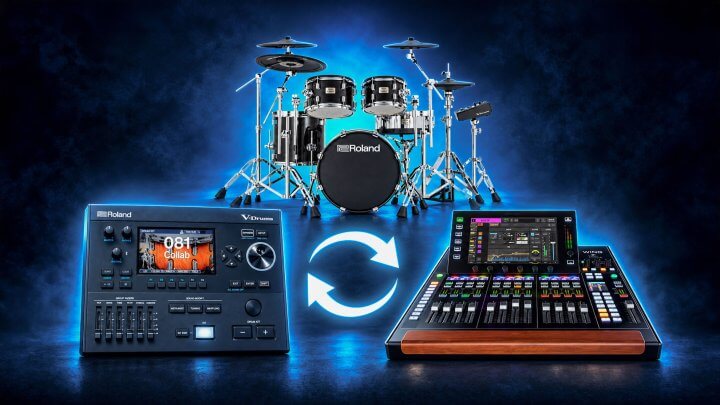
If you have the Roland V51 or V71 module, you can download my custom kit here.
Headphones remove the room, the sound system, and the rest of the band. A drum sound that is exciting in headphones may be muddy, harsh, or completely unbalanced through your PA.
Headphones are useful for getting started. The final adjustments must be made in the sanctuary, through the PA, with the band playing.
A stereo output can work well, but the internal balance has to be right. If the cymbals are ten times louder than the kick inside the module, the sound tech cannot fix that with one stereo fader.
Either build a carefully balanced stereo mix or use direct outputs to give the console separate control of important elements such as the kick and snare. Decide on the routing before Sunday morning.
The module may already be adding EQ, compression, room sound, overhead simulation, and reverb. Then the sound tech adds more EQ, more compression, and more reverb at the console. The result is an overprocessed kit that sounds distant and unnatural.
Know what the module is already doing. Decide which processing should happen where, and refrain from repeating the same things at both the module and the mixer.
This one completely defeats the purpose. Electronic drums remove the uncontrolled acoustic volume, but your PA is still capable of making them painfully loud. You don’t need to recreate the volume problem you just solved.
Give the drums enough level to create impact and energy, but keep them balanced with the vocals and the rest of the band. Control is the advantage. Use it.
So, can electronic drums actually sound good in church? Find out in this post →
©
Collaborate Worship. All rights reserved.