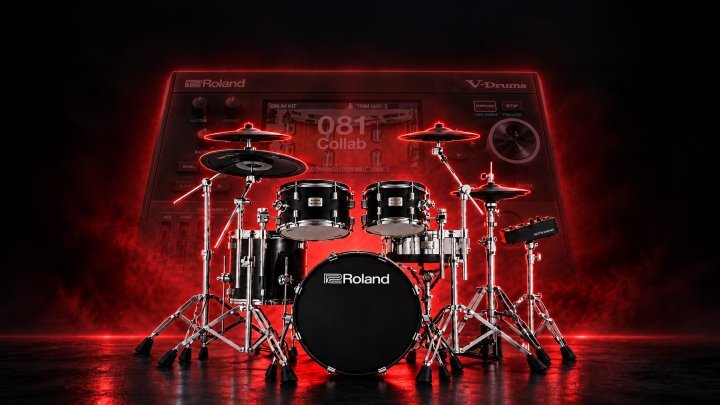
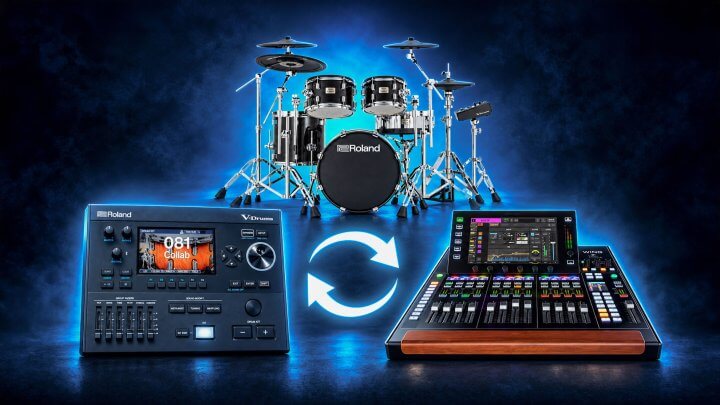
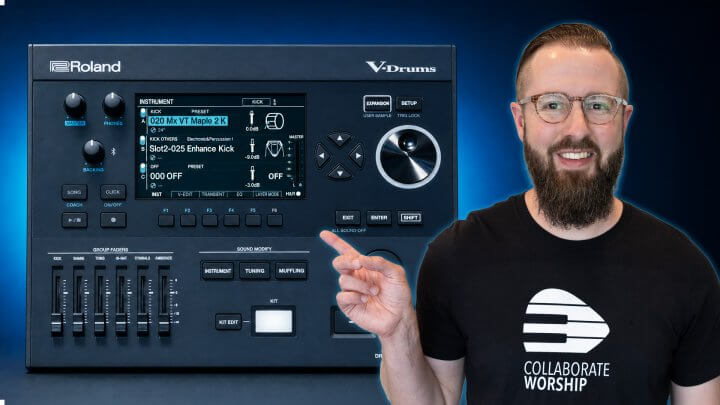
In our church, the Roland VAD516 electronic drums measured 27 dB quieter on average than the acoustic kit, with peaks dropping by 29 dB. More importantly, the lower stage volume gave us control over the cymbals, kick, and snare instead of forcing the entire worship mix to compete with the acoustic drums.

How much quieter are electronic drums than acoustic drums in a real church?
In our room, the difference was significant. Our acoustic kit averaged around 80 dB, while the Roland VAD516 electronic kit averaged 53 dB. Peak levels dropped from 86 dB to 57 dB.
Those numbers mattered, but the biggest improvement was not simply quieter drums. It was gaining control over the worship mix.
Before replacing our acoustic drum set, I wanted real numbers—not a theoretical comparison or a manufacturer’s claim. We pulled out a sound level meter and tested both kits in our church under normal conditions.
We measured the volume at the front and back of the room, keeping the measurement positions the same for both tests. We also used the same drummer, who played each kit at a similar intensity.
This was not a scientific laboratory test. The results will vary depending on the drummer, the room, the acoustic treatment, the drum set, the PA, and many other factors.
These measurements should not be treated as a universal promise about how much quieter electronic drums will be in every church. They show what happened when we compared the two setups in our room.
The electronic drums measured 27 dB lower on average. The peaks dropped by 29 dB.
The drums did not disappear, nor was that the goal. The practical difference was that the drum kit no longer established the room’s volume before we made any decisions at the sound system.
With the acoustic kit, the cymbals were already too loud before we added them to the PA. Turning down a cymbal channel could not remove the sound coming directly from the stage.
We had to build the rest of the band around the drum volume that was already in the room.
That is a difficult position for any church sound volunteer. Instead of deciding how loud the drums should be relative to the vocals and other instruments, you begin with an acoustic volume you cannot reduce. The rest of the mix then has to compete with it.
We could ask the drummer to ease up, but that was not a dependable way to set the cymbal level.
With the electronic kit, we now get to decide how loud the cymbals should be rather than continually asking the drummer to play them more quietly.
Once we switched to electronic drums, the mix became much easier. We could place the cymbals where they belonged, get consistent energy from the kick, and give the snare both punch and clarity.
That is the real advantage. Electronic drums are not merely quieter drums. They are controlled drums.
Instead of building the entire band around uncontrolled stage volume, we can shape the drum level through the sound system. The drums can still provide the energy the music needs, but the rest of the room no longer has to compete with sound we cannot turn down.
There is one important warning: replacing an acoustic kit does not automatically solve a church’s volume problem.
You can install electronic drums, turn them up through the PA until they are as loud as the acoustic kit, and completely miss the point.
The goal is not to find out how much drum sound your PA can produce. The goal is to create energy without forcing the entire room to compete with uncontrolled stage volume.
The electronic kit gives the sound team control, but the team still has to use that control intentionally.
Our measurements do not mean electronic drums are the right answer for every church. Your result will depend on your drummer, room, acoustic treatment, drum kit, and PA.
The central question is whether the acoustic drums are setting the room volume before they enter the sound system.
If the cymbals are already too loud and the rest of the band must be raised to compete, electronic drums may address the actual problem by giving the sound team control.
It is also worth evaluating the full journey before making the switch.
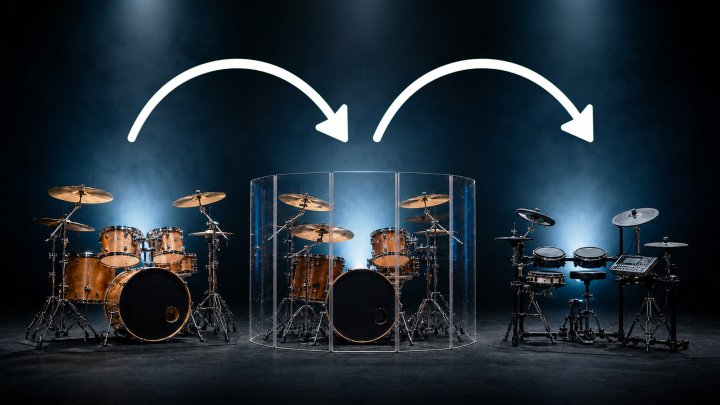
Our church moved from completely unshielded acoustic drums to a partial drum shield and then finally to electronic drums. Considering each stage can help you determine whether a shield, acoustic treatment, or an electronic kit is the right response in your room.
In our church, the electronic kit reduced the measured average level by 27 dB and lowered the peaks by 29 dB. More importantly, it stopped the acoustic drum volume from dictating the entire mix.
We could finally decide how much energy the drums needed without making everything else compete with the stage.
©
Collaborate Worship. All rights reserved.