Yes—the Behringer X32 is still worth considering for church sound in 2026. It remains affordable, capable, volunteer-friendly, and supported by abundant training resources. The key qualification: aging units may be harder to repair, and routing can overwhelm occasional operators.

Buying a digital mixer is not just a feature comparison. The real question is whether your team can create great sound without fighting the console every week.
That is why the Behringer X32 is still worth a serious look for churches in 2026—even though it first arrived in 2012.
We ran an X32 for almost a decade before moving to the Behringer WING, and we still pull the X32 out for certain occasions.
It is not the newest console, and there are clear reasons a church may want to move on. But it remains a capable, affordable workhorse when it fits the needs of the room and the people serving behind it.
The X32's biggest strength is that volunteers can learn the basics quickly. That matters more than it may seem when you are building a rotating church sound team.
A console can have an impressive feature list, but if a volunteer who serves once or twice a month cannot confidently make the basic adjustments, it creates friction every Sunday.
With the X32, the main tasks are approachable. New volunteers can get comfortable selecting channels, adjusting levels, shaping EQ, setting monitor mixes, and using effects without needing to understand every deeper part of the console immediately.
In our experience, new sound volunteers picked up those essentials in no time.
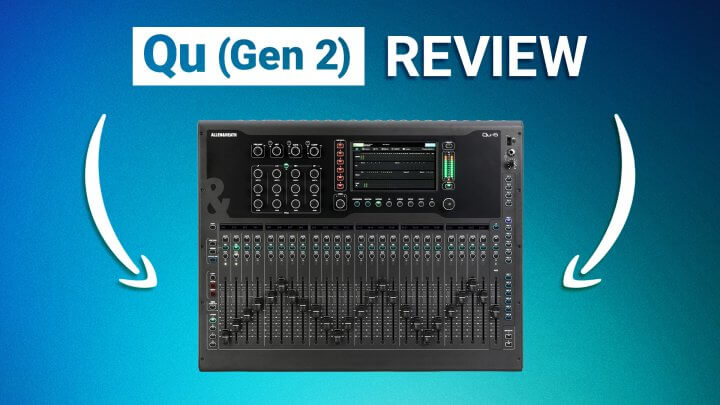
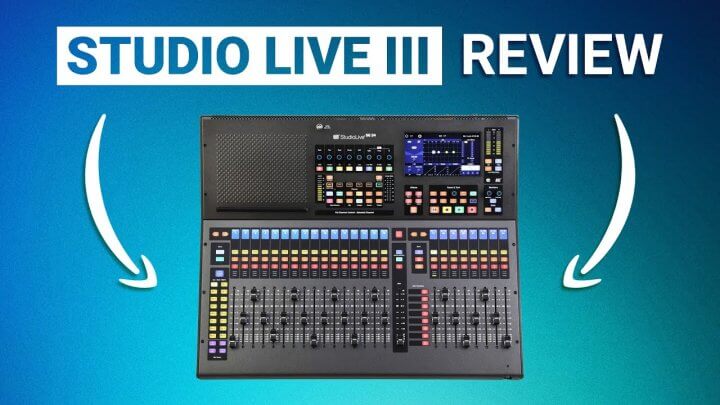
The X32 also still offers a strong feature set for its price, particularly on the used market. It has eight built-in effects slots, which is more processing than some newer entry-level consoles, including models in the Allen & Heath Qu line and the PreSonus StudioLive range.
For a church that needs practical processing without a large budget, that is meaningful. You have room to use the effects your worship mix needs rather than feeling constrained immediately.
Scene saving is another area where the X32 remains genuinely useful. You can save individual channel settings for rotating musicians, copy EQ settings from one channel to another, and recall a complete service setup in one action.
That is especially helpful in a church where multiple ministries use the room. The youth group can use the console on Friday night, and you can bring Sunday morning back to where you left it by recalling your show.
Scene recall is no longer a unique feature, but the X32 does it well enough that volunteers can actually use it as part of a normal workflow.
You can get better sound quality from newer mixers. That is true. But the X32 is clean, and for its age and price point, you should not be disappointed by its sound. It is still capable of producing a solid worship mix.
Do not let the age of the platform make you assume it cannot sound good.
The mixer itself is not automatically the thing keeping your church from getting a clear, musical mix. It remains a practical console for the vast majority of church sound needs.
The X32 has been around long enough that training resources are everywhere. There is more training available for it than almost any other mixer on the market.
Check out my X32 Mastery course →
That gives a church a real advantage when a volunteer is learning, when a staff member needs help with a problem, or when you need to bring in someone who already knows the platform.
Because so many churches and engineers have used the X32, there is a good chance someone on your existing team—or someone you can ask for help—already knows how to run it. That familiarity has value.
It can be the difference between a console that gets used confidently and one that becomes dependent on one highly technical person.
The X32 works, but in 2026 it shows its age in a few specific ways.
There is no touchscreen. You navigate the entire console with physical buttons and knobs.
That workflow is functional, but it feels very different from newer digital mixers. If your volunteers are used to modern touch-based interfaces, the X32 can feel slower and less intuitive at first.
This is not a reason to reject the X32 by itself. Plenty of people operate it effectively every week. It is simply part of the experience you should expect before buying one or deciding whether to keep yours.
The normal mixing functions are easy enough for newer volunteers, but routing is where the X32 becomes a bigger challenge. Output patching, AES50 configuration, and P16 setup can get complicated fast.
If you have one dedicated engineer who owns the system, that may be manageable. That person can build and protect the routing, while the rest of the team handles regular mixing.
But it becomes harder when the console is handed to someone who only serves once or twice a month and needs to troubleshoot a deeper setup issue.
Think carefully about who will be responsible for the system, not just who will mix on Sunday. The X32 is approachable at the surface, but the deeper configuration is less friendly for an occasional volunteer.
Everything on the X32 is mono: every input, output, and bus. When you need something to be stereo, it consumes two of those resources.
A stereo keyboard, a stereo effects return, or a stereo bus each uses two channels, two outputs, or two buses.
On a 32-input console, that is often completely workable. But it needs to be part of your planning. A church with multiple stereo keys rigs, stereo playback, several stereo effects, and lots of monitor needs can reach those limits faster than expected.
The X32 has been a day-to-day workhorse. But these consoles have now been in service for more than a decade, and aging gear can eventually have problems.
The bigger concern is not simply whether an X32 could fail. It is what happens when it does. Repair support is becoming harder to find, and replacement parts will not be easy to get.
If you are considering a used X32, factor that reality into the price. If your current X32 is still dependable, its age alone is not a reason to replace it. If it is beginning to have issues, though, moving up becomes a much more reasonable conversation.
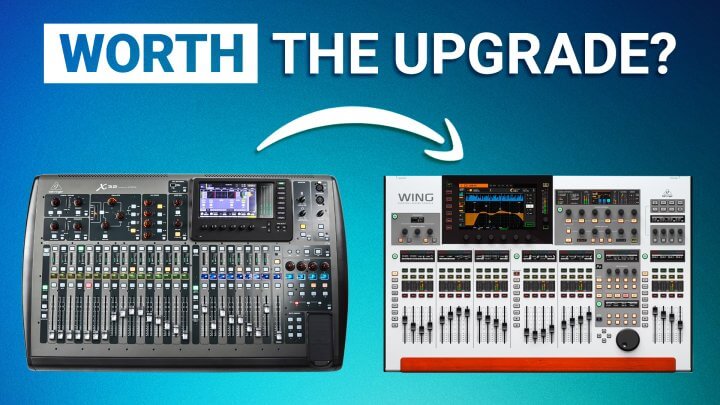
For many churches, the Behringer WING is the most natural upgrade path from an X32.
You can keep your stage boxes, P16 personal-monitoring system, and the broader ecosystem you already use, while gaining a more current console.
The WING gives you:
Those improvements are substantial. The touchscreen and stereo architecture alone can make day-to-day mixing feel more flexible. The added processing and recording capabilities also give a church more room to grow.
The tradeoff is that the WING is more complex.
You can get much more out of it, but setup can become more involved as you go deeper. New volunteers may face a slightly higher learning curve than they would on an X32.
The basics are still approachable, but the added flexibility means there is more to understand.
If your church is on a tight budget and needs a reliable console that volunteers can learn, the X32 is still a strong option. It is proven, affordable, and capable of covering the needs of a vast majority of churches.
Its processing, scene workflow, training availability, and familiar layout remain practical advantages.
If you have the additional budget for a WING, it is the better long-term purchase. You get more processing power, a touchscreen, better sound and effects, stereo channels and buses, built-in multitrack recording, and a more future-focused platform.
Just make sure your team has help learning the additional depth. My WING Mastery course will help with that.
If your current X32 is working well, there is no reason you cannot keep using it. But if it is beginning to have issues, your ministry has outgrown its available channels or buses, or the limitations of its routing and mono structure are creating regular friction, that is a sensible time to consider an upgrade.
©
Collaborate Worship. All rights reserved.