Central Baptist’s remodel shows that effective worship-tech upgrades start with the room: improve acoustics, add conduit and durable cabling, then choose volunteer-friendly gear and automation. The important qualification is that every solution must fit the church’s budget, staffing, room constraints, and ministry goals—not simply copy another installation.

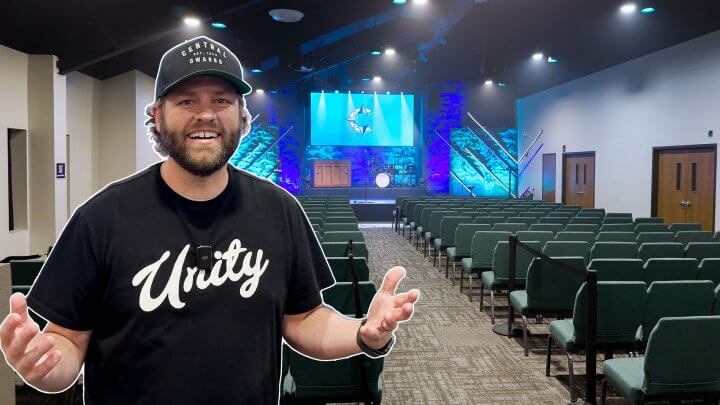
Central Baptist Church spent 16 months remodeling its facility while meeting in a youth worship center that held about 165 people for three services each Sunday. The new worship center is a great example of what it looks like to make wise AVL decisions in a renovation: improve the room first, spend where it matters, build infrastructure for the future, and keep the system practical enough for volunteers to run.
The room used to be wide and fan-shaped, with classrooms and mirrored walls behind the main seating area. The redesign brought the side walls in and added raised seating where those rooms used to be.
The result is a room that now seats roughly 650 people, up from about 400, but feels smaller and more connected rather than larger and more distant. That is a win.
When the person onstage feels like they are with the church rather than performing at people spread far away, the room is doing something right.
The ceiling stayed at its existing height, which was a practical compromise. Raising it would have affected HVAC, sprinklers, and a long list of construction costs. Instead of spending heavily on height, the church put resources into other parts of the project that would make a bigger difference.
One of those investments was acoustic treatment. Central Baptist used curved panels from Falcon Acoustics on the back wall and ATS rigid panels along the sides. The team installed many of the panels themselves. That is doable, but it is real work: hanging a roughly 40-pound panel while standing 15 feet in the air on a lift is not a casual Saturday project.
They did not claim the installation was acoustically perfect. Ryland said that, in hindsight, air gaps behind every panel might have improved the performance further. But the important result is that the room needed treatment and now sounds great. That is the point. Acoustic treatment is one of the purchases churches are tempted to cut because it is not flashy, but it changes what the congregation and mix engineer hear every week.
The front-of-house booth itself stayed in the same place, but the church gutted it and ran new conduit between the stage, booths, and broadcast spaces. During any remodel, run as much conduit as you reasonably can. It is boring infrastructure, but it gives you options when your needs change. Central Baptist could not easily drill into its existing post-tension slab, so putting pathways in place during construction mattered even more.
Every production position uses Magnus Pro sit-stand desks on wheels. That is a simple choice with a lot of practical value. An audio volunteer can stand while mixing worship and sit during the sermon. A teleprompter operator can work in whatever position helps them stay focused. And when something needs troubleshooting, the desk can be lifted and rolled out instead of requiring somebody to crawl under a fixed counter.
The lighting position is built around an Obsidian Onyx NX1 console. Ryland came from Chroma-Q Vista and found Onyx to be a different way of thinking. It sits somewhere between straightforward systems and the command-line style of larger consoles. There was a learning curve, especially with programming and command entry, but the integrator set the system up in a way that makes it approachable for a volunteer. That matters more than choosing a console just because it has a long feature list.
The NX1 provides 16 universes and connects to Elation nodes around the building through Art-Net or sACN. It also integrates with Doug Fleenor wall stations, so the room can still have usable lighting control when the main console is off. The church chose it partly because it delivered a robust system without pushing the budget into a much higher category.
On the fixture side, the team chose mostly Elation and Chauvet fixtures instead of relying entirely on inexpensive online fixtures as they had in the past. The difference they noticed was not just visual. The better fixtures were substantially quieter, which matters in a worship room. They still use a few inexpensive fixtures where it makes sense, but the primary fixtures were an intentional step up.
ProPresenter is the hub for lyrics, environmental content, stage displays, LED surfaces, lower thirds, and more. A Mac Studio with a Blackmagic DeckLink card supplies multiple 1080p outputs for those destinations. The value is not just having a lot of screens. It is giving each screen a clear job.
The lighting team sees cue notes pulled from the ProPresenter operator notes on a dedicated display. That means the operator can follow the planned cues and hit Go at the right time instead of trying to remember every change. The teleprompter operator runs Power Prompter, feeding a privacy-filtered display at the front of the booth that the pastor can see from the stage.
Ryland also fires most worship tracks himself from the stage. An Airstep MIDI pedal triggers a ProPresenter timeline that plays a multichannel audio file through a Focusrite Scarlett interface. Channels one and two carry pre-bounced stereo tracks, while channel three combines click and guide. The booth can operate the system if needed, but the worship leader can start the track exactly when the song begins.
That decision is tied directly to the congregation’s experience. When lyrics are late, people stop participating because they are waiting for the screen to catch up. Automating the timing of lyrics removes a common point of operator error. The church still has flexibility to repeat choruses or do songs without tracks, but it automates what needs to be consistent.
Two large stage displays provide current and next lyrics for the band. They sit low, just above the cameras, rather than high over the stage. That placement helps the musicians see them naturally and preserves better sightlines in the camera shots. For preaching, a separate low display becomes the pastor’s teleprompter screen. Big displays can replace a large projection screen effectively when they are positioned with the people using them in mind.
Instead of relying on AUX outputs from an ATEM to feed a handful of destinations, Central Baptist installed an 80-by-80 video router. That one change dramatically increases flexibility. Lobby displays, hallway screens, stage feeds, teleprompter content, and other destinations can receive different sources as needed.
The church ran 4K Belden SDI throughout the facility. The LED surfaces remain 1080p, but camera, streaming, and encoding infrastructure is 4K. Ryland’s thinking was solid: the cost increase to run 4K-capable SDI now was relatively small compared to paying for a second cable pull years later. They did not find a need for fiber because their camera systems do not require fiber backs, return feeds, and other fiber-dependent workflows. Fiber would have been useful for certain camera ecosystems and high-bandwidth return-video needs, but SDI was the right fit for this system.
The church does not use IMAG for normal services. The main exception is baptism, when they send a live camera feed to the main LED wall. That is another good reminder that system design should follow ministry needs. Do not build a permanent, complex IMAG workflow if you only need it a few times a year.
The camera package centers on Panasonic GH7 and Panasonic S5II cameras. The GH7 bodies work well with the church’s existing Micro Four Thirds lenses and are light enough for younger operators to handle comfortably. The S5II cameras provide a full-frame image and more background separation where that look matters.
One follow camera uses an S5II, a long lens, and a Smooth Camera Gear SCG-T8 fluid head. The team replaced older Manfrotto heads because they were not smooth enough. The newer heads offered better fluid movement without going into an unreasonable price range.
The camera monitors support touch autofocus with Panasonic cameras when USB is connected to the camera. Rather than expecting a 16-year-old volunteer to manage demanding focus control, the operator can touch the subject they need in focus. That is a smart example of designing a system around the volunteers you actually have.
The cable camera serves a different purpose. It uses a Greenbull dual-line cable system with a safety line above it, which is especially important because it travels over people. A Sony FX30 is used on that rig because power-zoom lenses let the operator zoom while the camera moves through its programmed path. The operator can control zoom speed, dolly speed, and preset movement to create the big parallax shots that show the congregation worshiping.
Wireless camera transmission is handled with Teradek Ace 750 units for 4K30 workflows, with a Teradek Bolt 6 on the cable camera. These have been reliable in this particular environment. The team also disabled the 6 GHz Wi-Fi band in the worship center on its UniFi system because the wireless video gear uses that spectrum. That does not guarantee every church will have the same results, but it is a worthwhile consideration when wireless systems are competing for RF space.
Hollyland tally gives camera operators a simple preview/program indication. The broadcast team uses Saramonic intercom systems with separate channels, allowing the director to speak to individual people without interrupting the entire camera line. The goal is not to own the most expensive intercom system. The goal is clear communication between a director, front of house, ProPresenter, and camera operators.
Broadcast video lives underneath the raised seating, making productive use of what would otherwise be dead space. The stream director has multiviews and access to approximately 12 cameras on a Sunday, including manned cameras, motorized dollies, and locked-off angles.
Bitfocus Companion and Stream Decks handle much of the show control. One button can change a source, bring up the right camera, turn on the live-stream host, and set the appropriate display destination. It also controls hallway TVs, HyperDeck functions, and other Blackmagic devices. Ryland chose to lean heavily into Bitfocus even though the building also has Q-SYS control available, because the existing modules, Stream Deck integration, and ability to control devices from a computer or phone make it very practical.
This is a helpful principle for churches: one platform does not have to do everything just because it technically can. Use the tool that makes the workflow easiest for your volunteers to understand and maintain.
Front of house runs on a Behringer WING, with a WING Compact in the broadcast-audio room. Ryland considered higher-end options when additional AVL funds became available, but Central Baptist already used the Behringer ecosystem elsewhere in the building. The WING had been dependable, and staying in a familiar ecosystem made practical sense.
The routing takes some learning. It can feel backwards at first, which is a familiar experience for people coming from more traditional console workflows. Once the team understood it, though, the WING gave them more capability than they currently need. The point is not that every church should buy the same console. It is that a system needs to be reliable, trainable, and appropriate for the people running it.
The broadcast WING Compact connects to front of house over AES50. It has the I/O needed for the broadcast position, and the built-in Waves card gives them the ability to insert Waves processing across channels when they need it. Dante is currently used for the Shure ULXD wireless microphones and Spotify through Dante Virtual Soundcard, not as the primary connection between the two WING consoles.
For level consistency, the team uses the AudioTools app with its compatible USB-C reference microphone. Every Sunday, the app provides a simple stoplight-style SPL reference. Their target during worship is to peak in the low 90 dBA range and generally live in the high 80s.
Those numbers are not a universal prescription. The room, band, PA, and congregation all affect the right level. A treated room that is properly EQ’d can feel full and powerful without feeling harsh. Two rooms may both measure 85 dB, while one feels much louder because the frequency balance is unpleasant. The live acoustic drum kit also establishes a baseline: if the drums are already loud in the room, everything else has to rise above them.
The installed PA is aligned and processed in the stage rack. The integration team helped the church listen, evaluate, and tweak the system rather than handing it over without explanation. Ryland specifically learned how speaker time alignment changes the physical feel of the room, including how the subwoofers interact with the rest of the system. That is why system processing should not be treated as a collection of arbitrary EQ moves.
The room now uses stereo rather than mono. They are not panning lead vocals away from part of the congregation, but stereo guitars, keys, and tracks retain their natural width. In a room that can support it, that creates more space and makes instruments such as piano feel more natural. It is a useful upgrade when the room and speaker deployment make sense for it.
Central Baptist moved from Behringer P16 personal mixers to Midas DP48 units. The P16 system had repeated reliability problems in this installation, including units dropping in and out even after cable changes and replacement hardware. The DP48 units have been solid, and the musicians immediately noticed an improvement in sound.
The singers’ mixers are mounted near their positions at the front of the stage rather than hidden backstage. Once a musician gets a good mix, they can generally leave it alone, but having the control nearby makes adjustments practical without interrupting the service.
The worship leader also has a wireless talkback setup connected through the WING’s GPIO. A footswitch can mute the normal vocal path and open a talkback path to the appropriate destination. It is used for simple communication, like encouraging the team near the end of the countdown, and for urgent instructions such as stopping tracks. A visible red reference light at front of house confirms that talkback is active before someone speaks.
The church uses a live DW drum kit in the worship center. Electronic drums had worked well in the youth center and solved many volume and control problems, but the team missed the authenticity of real cymbals. Their experience was that electronic drums can sound good, especially after a drummer has time to adapt, but rubber cymbals still do not respond exactly like acoustic cymbals.
The live kit uses a Lauten Audio kick microphone, new drum microphones, Heartbeat cymbals, and a Black Magic snare. Ryland was impressed by how little EQ the kick required. The kit also includes a Roland SPD-SX for samples.
One important troubleshooting discovery involved the snare trigger. Sending it through the SPD-SX introduced enough latency to cause the triggered snare and live snare to misalign, creating phasing problems. Moving to a separate Roland trigger system fixed the issue. When a sampled drum suddenly sounds hollow or inconsistent, do not only reach for EQ. Check whether the acoustic and triggered signals are arriving at different times.
They do not use traditional overhead microphones. Instead, they use side microphones primarily to provide cymbal content for the stream without putting tall boom stands in the shot. That is a deliberate compromise between idealized recording-studio technique and the visual needs of a live worship environment. The cymbals are not the most forward part of the mix, so the simpler approach serves the goal.
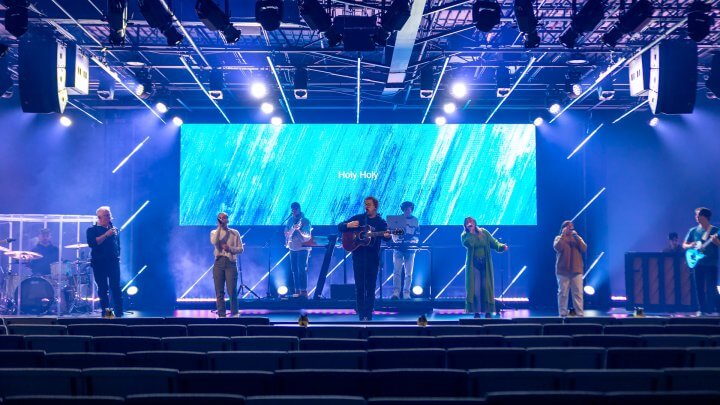
The rebuilt stage is 28 inches high, which is the height limit that avoided the need for sprinklers beneath it in this project. The church used a metal structure with a double-plywood top and carpet squares. Marley flooring had been installed initially, but it looked poor in the finished space, so they removed it and returned to carpet squares. The carpet has been more forgiving visually and does not need the same constant attention.
Accessibility and local building codes affected the design. A 28-inch-high stage would have required an extremely long ramp if the church had chosen that route, so they installed a chair lift instead. Every church needs to verify its own local requirements rather than copying another building’s solution.
Floor pockets across the stage carry power, video, Ethernet, audio tie lines, and DMX. Larger snakes serve the backline. This is exactly the kind of infrastructure that is hard to add later and easy to appreciate once the room is in use.
The main LED wall uses Unilumin ULX 2.5 panels, with separate movable scenic LED elements on the sides. ProPresenter drives the content. The scenic elements function like large, flexible light fixtures and can create different looks without rebuilding the stage. The main LED wall is mounted on motors so it can be lowered for service or used as a lower scenic backdrop. That required structural engineering, added steel, and a significant amount of coordination. Rigging something heavy above the stage is never a place to assume an existing beam can handle it.
The stage also includes an Antari CO2 haze unit. The team found CO2 haze to be a major improvement for their environment. A few inexpensive RGBALC LED fixtures add texture to the side walls through static gobos. They provide useful visual depth for little cost, but one fixture had a pinched wire on first power-up. Cheap fixtures can work, but inspect them carefully and use caution.
One layout lesson came from the portable baptistry fill and drain location. It sits near expensive stage equipment, so a leak would create unnecessary risk. If you are planning a renovation, think through every water connection and ask what happens if it leaks—not only how convenient it is during a baptism.
Ryland’s biggest frustration was receiving a formula-based AVL budget that did not reflect the actual vision for the room. The initial technology quote for the full project was far above the allocated amount. Have early conversations about how the room will be used, the kind of services you are building toward, and the technology those services require. A percentage of the overall construction budget is not automatically the right AVL budget.
Conduit, cable pathways, floor pockets, quality cabling, power, networking, and accessible rack locations will outlast cameras, microphones, consoles, and fixtures. Those are not exciting line items, but they prevent expensive compromises later. Central Baptist’s 4K SDI, conduit, and distributed stage connectivity are all examples of decisions that keep the building useful as equipment changes.
Central Baptist chose a local integration company, DC Pro, rather than a distant firm. That meant the team could receive support quickly when a fixture developed a color problem instead of collecting issues for months until a scheduled visit. For a major project, installation day is not the end of the relationship. Consider who will answer the phone and show up when something needs attention after the room is already in use.
This remodel did not happen because every decision was unlimited or perfect. It happened through good compromises: treating the room rather than rebuilding the ceiling, using a capable console the volunteers can learn, choosing equipment that fits the ministry, and investing in infrastructure that will still matter years from now. That is how you build a worship environment that supports the people in the room and the team serving behind the scenes.
©
Collaborate Worship. All rights reserved.