
If you’re thinking about upgrading your church’s mixer or stepping into digital mixing for the first time, the PreSonus StudioLive SE16 sits in a really interesting spot. It’s not trying to overwhelm you with endless features, but it also doesn’t feel limited once you actually start using it week to week.
This is one of those mixers that’s designed to help you get great results without adding unnecessary friction to your workflow.
In this post, I’m going to walk through what the SE16 offers, what it’s actually like to use, how it compares to other popular mixers, and ultimately who it’s best for.
Check out the Presonus Studio Live SE16 on Sweetwater
At a hardware level, the SE16 gives you a solid amount of flexibility for most church setups. You get 16 XLR combo inputs, two stereo aux inputs, eight XLR mix outputs, and additional outputs for routing flexibility. It also includes 34x34 multitrack recording directly to an SD card and a 64x64 USB interface for recording into your DAW.
One thing I really like is that every size in the SE lineup gives you access to 40 total channels. The difference between the 16, 24, and 32 versions is mainly how many physical faders and inputs you have built in. If you want to unlock all 40 channels on the smaller models, you’ll just need to add a PreSonus stage box.
Each channel includes everything you’d expect for modern mixing: polarity, high-pass filter, a four-band parametric EQ, compression, gating, and a limiter. You’re not missing anything essential here, which is huge for churches trying to keep things simple but still sound professional.
Grab our free Mixer Comparison Cheat Sheet to see how the specs stack up.
The SE16 gives you 26 mix buses, which is more than enough for most church environments. You get 16 flex mixes that can function as auxes, submixes, or matrices, along with four stereo effects mixes, a main LR mix, and dedicated subgroups.
What’s great about this is that it gives you room to grow without forcing you to use everything right away. If your team is mostly focused on getting vocals, instruments, and monitors dialed in, you can stay in that lane. But if you want to expand into more advanced routing later, the capability is already there.
You can also record directly to a computer via USB, whether you want full multitracks or just your stereo mix. And since it integrates easily with Studio One or other DAWs, it fits nicely into a modern workflow without extra steps.
This is where the SE16 really stands out. A lot of digital mixers look great on paper but feel clunky in real life, especially for volunteer teams. This one doesn’t.
The overall feel reminds me a lot of older analog boards in the best way possible. It’s intuitive. You can plug it in and start figuring things out without needing to immediately dive into the manual. Most of the core tasks like adjusting gain, EQ, compression, and faders feel straightforward and fast.
The physical controls are a big win here. The faders and buttons are responsive, and having a dedicated scroll wheel makes a bigger difference than you’d expect. It gives you a level of control that touchscreens alone just don’t.
The touchscreen itself is helpful, but it’s not the fastest on the market. That said, it’s supported well by the physical interface, so it never feels like a bottleneck. Routing can feel confusing at first, but once you understand how it’s laid out, it clicks and becomes easy to navigate.
One of the underrated features is the built-in effects. Not only do they sound good, but each effects engine comes with its own mute group already set up. That means you don’t have to spend time building extra routing just to control your effects.
Another big win is the built-in Wi-Fi. You can connect an iPad and start mixing remotely without needing additional gear. While I’d still recommend hardwiring when possible for stability, having Wi-Fi built in is incredibly convenient for smaller setups.
There’s also strong app support. You can mix from Universal Control on iPad, Mac, or Windows, and your band members can control their own monitor mixes using the QMix app. You can even lock them into just their mix so nothing else gets accidentally changed, which is a huge win for volunteer teams.
If you’re trying to decide between the SE16 and other popular options, here’s how it stacks up.
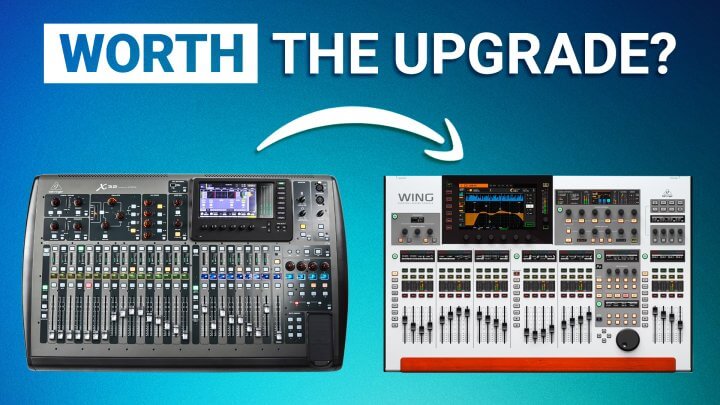
Compared to the Behringer X32, the SE16 feels more modern and easier for volunteers to navigate. The X32 still has a strong feature set, but its interface can feel dated and more complex.
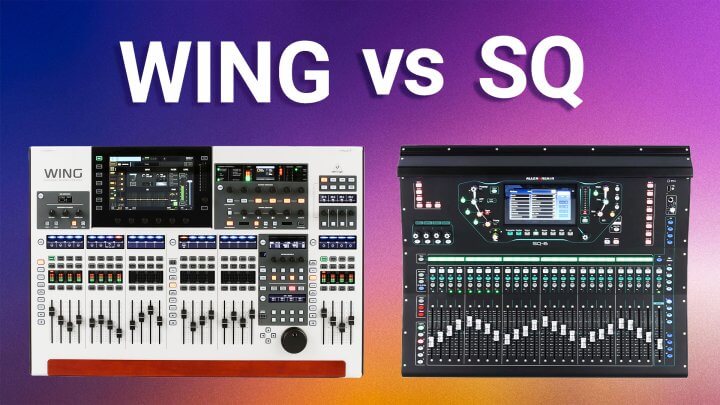
The Behringer WING gives you more advanced features and expandability, but it comes with a steeper learning curve. It’s powerful, but not always the best fit for teams that need simplicity.
The original Allen & Heath Qu-16 is simple and reliable, but it doesn’t have the same level of processing power or flexibility as the SE16. And with the smaller variants, you’re more limited by the built-in channel count.
Overall, the SE16 lands in a really solid middle ground. It gives you enough power to grow into without making things harder than they need to be.
The SE16 is a great fit for churches that want to move into digital mixing without overwhelming their team. If your volunteers are primarily focused on getting a solid mix each week and don’t need deep, complex workflows, this mixer makes that process easier.
It’s also a strong option if you’re upgrading from an older analog board and want something that feels familiar but adds modern capability. The learning curve is manageable, and the workflow makes sense pretty quickly.
And if you’re trying to balance budget with performance, this mixer hits a sweet spot. You’re getting a lot of functionality without needing to jump into higher-end price tiers.
At the end of the day, the PreSonus StudioLive SE16 isn’t trying to be the most advanced mixer on the market. It’s trying to be one of the most usable. And for a lot of churches, that’s exactly what matters.
If your goal is to create a great mix every week without fighting your gear, this is a mixer worth seriously considering. It keeps things simple where it should, while still giving you the tools to grow over time.